Why do parts fail after years of normal use, not one big load? In many cases, repeated stress is the real cause. This article explains the main types of fatigue testing apparatus and how each fatigue tester works. You will learn how these machines differ and how to choose the right one for specific testing needs.
The Main Machine Types of Fatigue Testing Apparatus
Fatigue testing apparatus can be classified in several ways, but one of the most practical approaches is to look at the machine platform itself. In real laboratory and industrial use, the main machine types are usually distinguished by how they generate cyclic force, the force range they can deliver, and the kinds of specimens they are built to handle. This is why buyers and engineers often compare a fatigue tester first by drive system before they look at fixtures, control modes, or industry-specific accessories. In broad terms, servo-hydraulic, electrodynamic, resonant, and pneumatic systems represent four of the most recognized machine categories in fatigue testing, each serving a different testing window rather than competing as direct substitutes for every application.
Machine Type | Main Strength | Best Suited For | Typical Limitation |
Servo-hydraulic fatigue testing apparatus | High force capacity and broad test versatility | Large specimens, structural parts, low-cycle fatigue | Requires hydraulic infrastructure and more maintenance |
Electrodynamic fatigue tester | Clean operation and high-frequency precision | Medical devices, electronics, small components | Lower force range than heavy-duty hydraulic systems |
Resonant fatigue testing apparatus | Extremely efficient high-cycle testing | High-cycle and ultra-high-cycle fatigue studies | Less flexible outside resonance-based conditions |
Pneumatic fatigue tester | Simple and cost-effective repetitive loading | Light-duty cyclic tests, elastomers, short-life tasks | Limited precision, force range, and application scope |
Servo-hydraulic fatigue testing apparatus
Servo-hydraulic systems are widely regarded as the standard choice when high dynamic loads are required. They use hydraulic actuators to apply repeated tension, compression, bending, or combined loading, which makes them especially valuable in laboratories that need one platform to support several fatigue test methods. In practical terms, this type of fatigue testing apparatus is often chosen for large metal specimens, welded structures, aerospace parts, and other applications where load capacity matters as much as control accuracy.
Their biggest advantage is not just force output, but range. A servo-hydraulic system can be configured for different specimen sizes and can often support fracture mechanics work in addition to conventional fatigue life testing. That flexibility explains why these machines remain common in research, automotive, and heavy engineering settings even though they require hydraulic power packs, more space, and more maintenance attention than cleaner electric systems.
Electrodynamic fatigue tester
An electrodynamic fatigue tester is typically selected when the testing task involves smaller parts, higher frequencies, and a cleaner lab environment. Instead of hydraulic oil, these systems rely on electromagnetic or linear motor technology to generate cyclic motion. This makes them quieter in operation and attractive for industries that place a premium on precision, cleanliness, and easier maintenance.
This machine type is especially useful for devices such as implants, sensors, fine mechanical assemblies, and compact consumer or industrial components. While it cannot usually match a servo-hydraulic system in sheer force capacity, it can outperform heavier systems in applications where specimen size is small and testing speed is important. For many labs, that makes electrodynamic equipment less of a replacement for hydraulic machines and more of a specialized platform for cleaner, more precise fatigue evaluation.
Resonant fatigue testing apparatus
Resonant fatigue testing apparatus is designed for efficiency at very high cycle counts. Instead of forcing cyclic loading across a wide operating range, it uses the natural resonance of the specimen-fixture system to achieve large numbers of cycles with relatively low energy input. This feature makes it highly attractive for high-cycle fatigue and ultra-high-cycle fatigue studies, where test duration can otherwise become impractical.
The value of this machine type lies in speed and efficiency rather than universal adaptability. When the goal is to push a material toward millions or even billions of cycles, resonant systems offer a practical route that conventional machines may struggle to match economically.
Pneumatic fatigue tester
A pneumatic fatigue tester is generally a lighter-duty alternative used for repetitive loading tasks that do not demand the heavy force range or precision of more advanced systems. These machines use compressed air to create cyclic motion, making them relatively simple in design and often more accessible for targeted testing applications.
Their strength is simplicity, but that simplicity also defines their limits. Compared with servo-hydraulic and electrodynamic systems, pneumatic machines are usually more restricted in load control, force capacity, and overall testing scope. They fit best where the test requirement is straightforward and the apparatus does not need to cover a wide range of fatigue scenarios.
Fatigue Tester Types Based on How the Load Is Applied
Another practical way to classify a fatigue tester is by the way cyclic stress is introduced into the specimen. This approach is often more useful to engineers than machine-platform categories alone, because the load path has to reflect the real service condition of the part being evaluated. A component that repeatedly stretches and compresses in use should not be tested in the same way as one that mainly bends or twists. For that reason, axial, bending, and torsional systems are among the most important load-based categories in fatigue testing.
Load Application Type | How the Load Acts on the Specimen | Common Use Focus |
Axial fatigue testing apparatus | Repeated tension and compression along the specimen axis | Standard fatigue life evaluation, S-N data, material comparison |
Bending fatigue testing apparatus | Repeated flexural stress on the surface and across the section | Endurance studies, sheet materials, beams, weld zones |
Torsional fatigue tester | Repeated twisting around the specimen axis | Shafts, wires, fasteners, torque-loaded components |
Axial fatigue testing apparatus
An axial fatigue testing apparatus applies repeated tensile and compressive force along the length of the specimen. Because the load is introduced directly through the specimen axis, this format is one of the most widely used for standard fatigue life evaluation. It is especially useful when laboratories need comparable and repeatable data for metals, alloys, polymers, or other engineering materials under controlled cyclic loading. In many testing programs, axial systems are used to generate baseline fatigue data because the setup is relatively straightforward and the stress state is easier to define than in more complex loading modes.
Another reason axial systems are so common is that they align well with standard specimen forms and support both low-cycle and high-cycle testing strategies, depending on control mode and machine capability. They are frequently selected for general research, quality comparison, and material qualification work, where the goal is to understand how long a specimen survives under a known cyclic force history rather than to reproduce a highly specialized component geometry.
Bending fatigue testing apparatus
A bending fatigue testing apparatus is designed for specimens that experience repeated flexural stress in service. Instead of loading the specimen purely in tension and compression through its centerline, these testers create alternating stress through bending action, which makes them valuable when surface stress and flexural endurance are the main concerns.
Rotating beam machines are often used for endurance limit studies because they provide an efficient way to expose the specimen surface to alternating tensile and compressive stress as the sample rotates under a bending moment. Plane bending systems, by contrast, are useful for flat materials, thin sections, and welded specimens where deformation occurs within a defined plane. This makes bending-based fatigue testing apparatus particularly relevant for sheet products, beams, springs, and other parts whose real operating condition is governed more by flexure than by direct axial force.
Torsional fatigue tester
A torsional fatigue tester applies cyclic twisting around the specimen axis and is used when torque is the dominant service load. This makes it highly relevant for parts such as shafts, drill elements, wires, screws, fasteners, and other components that must withstand repeated rotational stress.
In practice, torsional systems are selected when crack initiation, deformation, or failure is expected to result from repeated torque rather than direct pulling or bending. They are also valuable when designers need a more realistic assessment of parts used in transmission, fastening, rotation, or cyclic torque transfer, where the fatigue mechanism is directly linked to twisting load history rather than to simple linear motion.
Specialized Fatigue Testing Apparatus for More Complex Testing Needs
Standard axial, bending, or torsional setups are often enough for basic fatigue life evaluation, but many real engineering failures happen under more complicated conditions. In practice, parts are frequently exposed to combined stresses, changing temperatures, or geometry-specific motion that cannot be represented well by a simple specimen test. That is where specialized fatigue testing apparatus becomes essential.
Specialized Apparatus Type | What It Simulates | Typical Application Focus |
Multi-axial fatigue testing apparatus | Combined loading in more than one direction | Automotive, aerospace, complex structural components |
Thermomechanical fatigue tester | Cyclic load with changing temperature | Engine parts, turbine blades, high-temperature materials |
Component-specific fatigue testers | Real product geometry and service motion | Springs, wheels, hubs, product-level durability testing |
Multi-axial fatigue testing apparatus
A multi-axial fatigue testing apparatus combines two or more loading directions in a single test, such as axial and torsional loading applied at the same time. This matters because real components rarely fail under one perfectly isolated stress mode. Suspension parts, aircraft joints, and powertrain components are more likely to experience interacting stresses that shift during service.
Thermomechanical fatigue tester
A thermomechanical fatigue tester adds another level of realism by combining cyclic mechanical loading with controlled temperature change. Instead of evaluating a material only at room temperature, this apparatus reproduces conditions in which heating, cooling, expansion, and repeated stress act together over time. This type of machine is especially relevant for engine components, turbine parts, and other materials exposed to severe thermal cycling.
Component-specific fatigue testers
Component-specific fatigue testers are built around the actual form and movement of a finished product rather than a standard specimen shape. These machines are commonly developed for springs, wheels, hubs, zippers, and other application-specific parts whose service motion cannot be represented accurately by a generic laboratory fixture. This makes them especially useful in product validation, where the goal is not only to understand material fatigue, but to verify whether the finished component will survive its intended working cycle.
How to Choose the Right Fatigue Testing Apparatus
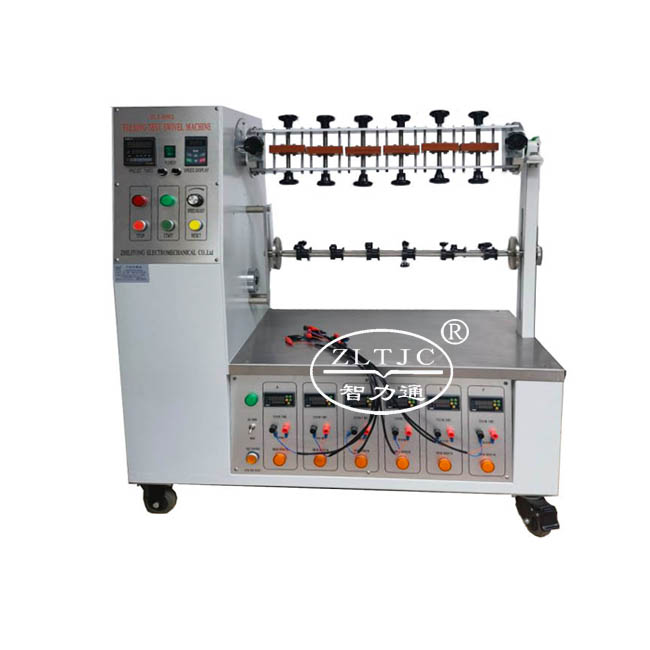
Choosing the right fatigue testing apparatus starts with a simple but often overlooked question: what exactly is the test supposed to prove? Not every fatigue program has the same objective. Some tests are designed to compare the fatigue performance of different materials under controlled laboratory conditions, while others are used to validate a finished component, investigate failure behavior, or estimate service life under realistic loading. If that purpose is not defined first, it becomes easy to choose a machine with impressive specifications but poor relevance to the actual testing task.
Selection Factor | What to Ask First | Why It Matters for Machine Choice |
Testing purpose | Is the goal material comparison, component validation, or life prediction? | Determines whether a standard specimen system or a product-specific setup is needed |
Cycle range and load level | Is the test low-cycle, high-cycle, or ultra-high-cycle, and how much force is required? | Influences the choice between hydraulic, electrodynamic, resonant, or lighter-duty systems |
Specimen and service condition | What shape, loading direction, and environment must be reproduced? | Ensures the apparatus reflects real working conditions instead of only laboratory convenience |
Start with the testing purpose
The first step is to define the testing purpose in practical terms. A laboratory comparing the fatigue behavior of two alloys may only need a standard axial or bending system with good control and repeatability. By contrast, a manufacturer validating a wheel hub, spring, or medical component may need a much more application-specific machine. Service-life prediction adds another layer, because the machine must reproduce the stress history closely enough for the data to support engineering decisions. This is why the right fatigue tester is not selected by machine type alone, but by how well it supports the question the test program is trying to answer.
Match the apparatus to the cycle range and load level
Cycle range is another critical selection point. Low-cycle fatigue usually involves higher stress or strain levels and fewer cycles, which often favors robust systems such as servo-hydraulic machines. High-cycle fatigue places greater emphasis on long-duration cyclic loading, while ultra-high-cycle work may call for resonant systems that can reach very large numbers of cycles more efficiently. Frequency range matters as well, because not every machine platform can deliver both the required load and the required speed with stable control.
Consider the specimen shape and real service condition
Specimen shape and service condition should guide the final selection. A small straight specimen, a welded plate, a torsion-loaded shaft, and a finished spring do not require the same apparatus even if all are being tested for fatigue. Geometry affects fixturing, alignment, stress distribution, and the kind of load the machine must apply. Environmental factors matter too, especially when fatigue performance changes under heat, corrosion, or other service conditions. In practice, the best machine is the one that reproduces the real working condition of the specimen as closely as necessary, because fatigue results become far more useful when the laboratory test reflects how the part actually performs in service.
Conclusion
The main types of fatigue testing apparatus include platform-based and load-based systems, from servo-hydraulic and resonant machines to axial and torsional testers. The right fatigue tester depends on real test goals, load patterns, and specimen conditions. Guangzhou Zhilitong Electromechanical Co., Ltd. delivers practical value through reliable testing equipment, application-focused features, and professional service that helps customers improve product quality and testing efficiency.
FAQ
Q: What are the main types of fatigue testing apparatus?
A: The main fatigue testing apparatus types are servo-hydraulic, electrodynamic, resonant, pneumatic, axial, bending, torsional, and multi-axial systems.
Q: How do I choose the right fatigue testing apparatus?
A: Choose fatigue testing apparatus based on load type, cycle range, specimen geometry, and whether the goal is material testing or component validation.
Q: What is the difference between an axial and a bending fatigue tester?
A: An axial fatigue tester applies tension-compression loads, while a bending fatigue testing apparatus applies repeated flexural stress.
Q: When is a multi-axial fatigue tester necessary?
A: A multi-axial fatigue tester is necessary when the part experiences combined stresses, such as axial and torsional loading in service.


