Introduction
Why do cables fail after ordinary daily use? In many cases, repeated bending causes the damage, not one sudden overload. A cable fatigue test recreates that motion in a controlled way with a fatigue testing apparatus or fatigue tester. In this article, you will learn how the test works, what the results mean, and how to choose the right tester for cable applications.
How a cable fatigue test is carried out in practice
Defining the real-use bending condition
A cable fatigue test starts with one practical question: where and how does the cable actually bend in service? In most products, failure does not happen randomly along the cable length. It usually develops near high-strain zones such as plugs, molded connectors, strain-relief sleeves, or the point where the cable enters a housing. For that reason, the first step is not choosing a machine setting, but mapping the real bending behavior the product sees during daily use. This includes identifying the bend location, the likely direction of movement, the approximate bend radius, and whether the motion is one-way, alternating, or repeated around a fixed point. The goal is to reproduce service stress in a controlled lab setup rather than apply a generic motion that looks convenient but does not reflect reality. That same logic is consistent with fatigue testing practice more broadly, where loading conditions are selected to match operational use and the expected failure mechanism.
Once that service pattern is understood, the test parameters can be defined. The bending angle, travel path, frequency, and target cycle count are chosen according to the intended product use. A charging cable that is bent repeatedly near a connector needs a different motion profile from an industrial cable routed through a guided flex path. In a useful test plan, the movement is tied to a real handling scenario: repeated plug-side flexing, oscillation at an entry port, or continuous dynamic bending in equipment. This makes the output more meaningful for design, material comparison, and reliability decisions.
Mounting the sample in the test position
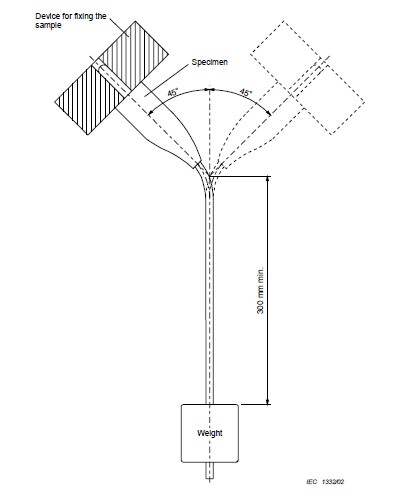
Before cycling begins, the sample has to be installed so the bending event happens at the intended point every time. The cable is fixed in place with clamps or fixtures that prevent slipping while avoiding accidental damage from over-tightening. The exact bend point is positioned relative to the clamp, the moving arm, and the support geometry so that each cycle concentrates stress in the same zone. If the test is designed to simulate hanging use or pull-assisted bending, an attached load may be added at the free end to maintain tension and stabilize the motion path.
The setup stage also includes checking alignment, initial cable straightness, and connector orientation. Small positioning errors can shift the highest-strain area away from the intended location and distort the result. In practice, consistency in fixturing matters just as much as the fatigue tester itself because repeatable mounting is what makes one sample comparable to the next.
Setup factor | Why it matters in cable fatigue testing |
Clamp stability | Prevents sample slip and keeps the loading position consistent |
Bend point location | Ensures damage develops at the intended service-critical area |
Added load or tension | Helps simulate real use and stabilizes repeated motion |
Alignment of cable and connector | Reduces unintended twisting or off-axis bending |
Running the bending cycle
Once mounted, the cable is flexed repeatedly through the preset motion. The fatigue tester moves the sample through a fixed angle or path at a controlled speed, then returns it to complete one cycle. This motion continues automatically until the test reaches its endpoint, which may be a required cycle count, electrical discontinuity, visible damage, or mechanical failure. During execution, the emphasis is on maintaining the same movement pattern from cycle to cycle so the test reflects cumulative bending fatigue rather than random handling variation.
What a fatigue testing apparatus or fatigue tester actually does
Creating stable and repeatable motion
A fatigue testing apparatus is built to generate the same mechanical movement again and again under controlled conditions. In cable evaluation, that usually means repeated bending, flexing, or oscillation at a defined point without the variation that comes with hand-operated checks. Manual testing may be useful for quick observation, but it cannot hold a constant angle, speed, path, and timing over hundreds, thousands, or even millions of cycles. That gap is exactly why dedicated equipment is used when durability data needs to be trusted.
Repeatability is the real value of the equipment in both quality control and compliance work. When the same motion profile is applied to multiple samples, differences in performance are more likely to come from the cable design, materials, conductor structure, insulation, or strain-relief geometry rather than from operator inconsistency. This makes the apparatus useful not only for development testing but also for production verification, where results must remain comparable across batches, test dates, and operators. A stable mechanical system also reduces noise in the data, which matters when engineers are trying to identify early-life weakness rather than only catastrophic breakage.
Controlling the key test parameters
A fatigue tester does more than move a cable back and forth. It allows the operator to define the specific variables that shape the test condition. Depending on the setup, the machine can set the bending angle, movement speed, total cycle count, and any applied load used to keep the sample under realistic tension. These parameters are chosen to reflect product use or a required procedure, then held constant throughout the test so the loading condition remains consistent from the first cycle to the last.
Controlled parameter | What the fatigue tester does |
Bending angle | Keeps the flex range fixed from cycle to cycle |
Test speed | Maintains a consistent movement rate throughout the run |
Cycle count | Tracks and stops at the required number of repetitions |
Applied load | Holds the sample under a defined tension or hanging force |
Because these settings are machine-controlled, the test becomes reproducible rather than approximate. That control is especially important when comparing designs, validating revisions, or documenting a method for internal or external review.
Supporting standard-based cable evaluation
Many cable bending and flexing checks are performed against established test methods, so the apparatus is designed to support structured execution rather than ad hoc handling. In practice, that means the equipment can maintain a defined motion path, hold the sample in a repeatable fixture position, and run for the required duration without drift. For regulated or specification-driven products, the purpose of the machine is to provide a controlled platform that aligns with standardized cable evaluation procedures. Its role is to execute the prescribed mechanical action accurately and consistently, creating a reliable basis for later inspection, measurement, or documentation.
What test results show about cable durability
Cycles to failure
One of the most important outputs in a cable fatigue test is cycles to failure—the number of bending repetitions the sample completes before it no longer meets the test requirement. This result gives engineers a practical way to estimate how well a cable can withstand repeated use at a stress point such as a connector, plug exit, or entry port.
By itself, cycle count is not just a raw number. It becomes meaningful when tied to the intended application. A cable used in light office handling and a cable used in constant-motion equipment may require very different bending-life expectations. That is why the result helps estimate durability under repeated use, but only in the context of the defined motion, angle, speed, and load used during the test.
Electrical continuity during and after testing
A cable can still look acceptable on the outside and yet fail functionally. The jacket may remain largely intact while the conductor inside has cracked, partially broken, or developed an intermittent connection. For this reason, electrical continuity monitoring is a critical part of interpreting cable fatigue results. It reveals whether the cable still performs its intended electrical function during cycling, not only whether it retains its outer shape.
Continuity checks may be performed during the test, after the test, or both. In-test monitoring is especially valuable because some failures are intermittent rather than permanent at first. A cable may pass a visual inspection immediately after bending, but still show signal interruption, unstable contact, or open-circuit behavior under movement. That makes continuity a key indicator of functional durability rather than cosmetic survival.
Visible and structural signs of damage
Physical inspection helps show where the cable design is weak and how damage develops. The result may reveal external jacket cracking, localized insulation wear, deformation near the bend point, or a visibly weakened flex zone. In more severe cases, the test may expose conductor fracture, broken strands, separation near a termination, or damage concentrated at the transition between the flexible cable body and a stiffer connector area.
Result type | What it may reveal about cable weakness |
Early cycle failure | Insufficient fatigue resistance for repeated-use conditions |
Loss of continuity | Internal conductor damage or unstable electrical connection |
Jacket or insulation cracking | Poor resistance at the outer bending surface |
Damage concentrated at one flex point | Stress concentration caused by structure or geometry |
What pass or fail really means
A pass or fail result is not based on appearance alone, and it is not an abstract judgment. It has to be assessed against the relevant product requirement, internal specification, or applicable test standard. In some cases, passing means surviving a required number of cycles while maintaining continuity. In others, it may also require no unacceptable structural damage at the specified inspection points. A cable that survives many bends but fails the defined electrical or physical criteria still does not meet the requirement, because fatigue performance is judged against the stated acceptance condition rather than a general impression of toughness.
How to choose the right fatigue tester for cable products
Match the tester to the cable type
Choosing the right fatigue tester starts with understanding what kind of cable you need to evaluate and how it is used in the field. Not all cable products bend in the same way, and not all failures occur under the same motion pattern. A power cord designed for repeated plug-side flexing may need a different setup from a light-duty flexible cable used in handheld electronics, while an appliance lead may require a fixture that better reflects strain near the entry point or molded termination.
This is why buyers should first check whether the tester supports the required bending direction, angle range, clamping style, and load arrangement for the cable category they handle most often. A mismatch between product structure and test motion can make the equipment less useful, even if the machine itself appears well built. Selection should therefore begin with application fit rather than with headline specifications alone.
Check the machine’s testing capacity
Once the test method is clear, the next decision is whether the machine can support the expected workload and sample range. For procurement, capacity is not only about maximum output, but also about day-to-day practicality in a lab or factory environment. A suitable machine should accommodate the cable dimensions you test, allow adjustment for different product formats, and provide enough stations for your throughput target without making setup unnecessarily complex.
Selection factor | Why it matters when buying a cable fatigue tester |
Number of stations | Affects throughput and batch comparison efficiency |
Adjustment range | Determines whether different bend angles and fixture positions can be set |
Sample size compatibility | Ensures the tester can handle the cable diameter, length, and termination style you use |
Fixture adaptability | Helps the machine support different cable constructions without constant modification |
A buyer looking at long-term value should also consider whether the same platform can cover multiple cable products instead of serving only one narrow test scenario.
Look at control and detection features
Control and detection features directly affect procurement value because they reduce labor, improve consistency, and lower the chance of incomplete results. Functions such as automatic cycle counting, programmed shutdown, and continuity detection make the testing process easier to manage at scale. Automatic counting removes the need for manual tracking, while shutdown at a preset endpoint helps prevent overtesting and unnecessary operator supervision.
Continuity detection adds another layer of value because it captures functional failure that may not be visible from the outside. For purchasing decisions, this matters because a machine with integrated detection can streamline documentation, reduce separate inspection steps, and improve result reliability. In specification terms, these features are not simply conveniences; they help turn the tester into a more efficient qualification and quality-control tool.
Conclusion
A cable fatigue test works by bending a cable under controlled conditions until a defined result is reached. This process shows how the test runs, how the fatigue testing apparatus ensures repeatable motion, and how results reveal real durability. The right fatigue tester must match the product and application. Guangzhou Zhilitong Electromechanical Co., Ltd. provides reliable testing equipment with practical features that help improve accuracy, efficiency, and cable quality evaluation.
FAQ
Q: What does a fatigue testing apparatus do?
A: A fatigue testing apparatus applies controlled cyclic motion to measure cable durability under repeated bending.
Q: How is a fatigue tester different from manual flex testing?
A: A fatigue tester delivers repeatable angle, speed, and cycle control that manual testing cannot maintain consistently.
Q: What results come from a fatigue testing apparatus?
A: A fatigue testing apparatus records cycles to failure, continuity loss, and visible damage at critical flex points.
Q: How do you choose a fatigue tester for cable products?
A: A fatigue tester should match cable type, bending setup, sample size, and required test standard.


