Many cables fail from repeated bending, not one sudden overload. So, what is a fatigue testing apparatus, and why does it matter? In this article, fatigue tester refers to cable bending and flexing cycle equipment used for quality and compliance checks. You will learn how it works, what standards it supports, and how to choose the right setup.
What Is a Fatigue Testing Apparatus in Cable Testing?
What problem does a cable fatigue tester solve?
In cable testing, a fatigue testing apparatus is used to find out how well a cable or flexible cord survives repeated bending, swivelling, and movement during normal use. This matters because cable failure is often not caused by one extreme load, but by thousands of smaller movements concentrated near plugs, cord entries, or other stressed points. A cable fatigue tester recreates that repeated motion in a controlled way, helping manufacturers spot weak designs before products reach the market.
The need is especially clear in products that are handled frequently or move during operation. This includes electric tools, hand lamps, and other appliances with cords that bend again and again during daily use. In these applications, a small weakness in conductor structure, cable entry design, or assembly can turn into an early open circuit or mechanical failure. That is why this equipment is not just a lab tool. It is a practical durability-checking device for safety, consistency, and quality control.
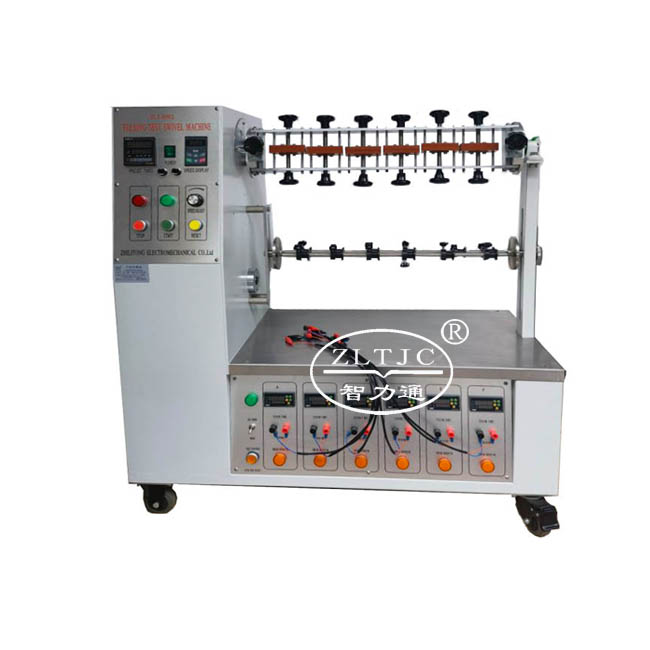
How this type of fatigue testing apparatus is different from general mechanical testers
Unlike a broad-purpose mechanical tester, this kind of fatigue testing apparatus is built specifically for continuous cable bending or flexing evaluation. It uses dedicated sample holding parts, bending components, mandrels, and controlled drive systems rather than a universal setup intended for many unrelated materials. That product focus matters because cables behave differently from rigid specimens. They must be tested in their real configuration, often with plugs or cable entries attached, so the bending action reflects actual service conditions rather than an abstract material-only test.
Aspect | Cable Fatigue Testing Apparatus | General Mechanical Tester |
Main purpose | Repeated cable bending or flexing validation | Broad material or component force testing |
Typical specimen | Flexible cords, cables with plugs or cable entries | Generic material samples or rigid parts |
Motion style | Controlled swivelling or bending cycles | Load, compression, tension, or other general actions |
Real-use focus | Simulates movement seen in cord applications | Often evaluates broader mechanical behavior |
Where it fits in compliance and product validation
This apparatus sits at the point where product durability, compliance, and release decisions meet. It is used to verify whether a cable or flexible cord can meet required durability expectations before certification, shipment, or product release. In practice, it helps produce repeatable evidence that a cable design can withstand the bending conditions expected in service.
It also plays a useful role in product comparison and design review. When engineers need to evaluate different cable structures, strain relief solutions, or cord entry designs, a fatigue tester provides controlled data instead of guesswork. That makes it valuable in both compliance testing and internal validation programs.
How Does a Cable Fatigue Testing Apparatus Work?
The basic test principle behind bending and flexing
A cable fatigue testing apparatus works by subjecting a cable sample to repeated, controlled movement until the sample reaches a preset number of cycles or shows a failure event. In practice, the motion is usually a bending or swivelling action designed to reproduce the kind of stress a cord experiences in everyday service near a plug, cable entry, or frequently moved section. One common test use is checking the resistance to bending fatigue of a solid conductor, while another focuses on continuous bending performance evaluations of cables through controlled swivelling movements.
That distinction is useful because it shows the same testing principle being applied to slightly different cable-testing purposes. One setup may focus on conductor bending resistance, while another may examine repeated flexing of complete cable assemblies in realistic configurations. In both cases, the goal is to simulate repeated movement under defined conditions and see whether the cable can endure it without failure.
Key parts that make the fatigue tester work
To perform this test reliably, the apparatus combines mechanical holding, controlled movement, and automated tracking. Typical systems include a clamping or sample-fixing device, a metal plate or mandrels for controlled bending, a drive system, PLC-based control, and a counter system for cycle tracking and event recording. Together, these parts keep the specimen stable, apply repeatable motion, and make the test measurable rather than purely observational.
Component | Function in the Test Process |
Clamping or sample-fixing device | Holds the cable securely so movement is applied at the intended stress point |
Metal plate or mandrels | Guides the bend radius and creates repeatable mechanical stress |
Drive system | Produces the continuous bending or swivelling motion |
PLC-based control | Maintains stable, repeatable operating conditions across the test |
Counter system | Tracks target cycles and records failure-related events such as open circuits |
What parameters are usually set during testing
Before the machine starts, the operator usually sets the main conditions that define the severity and relevance of the test. These often include the swivelling angle, test frequency, applied weights or load conditions, target cycle count, and open-circuit or failure recording method. In a cable flexing application, the angle may be adjusted to suit the test standard, while the movement speed can be set within a defined range so the cable experiences a repeatable stress pattern.
Load conditions also matter because the same cable may behave differently under different hanging weights or restraint methods. Some fatigue testers support several weight sets to simulate practical use conditions for different cable types. Predetermining counters can stop the machine automatically when the target cycle count is reached, while individual counters record when a specific sample fails. These settings help match the test to real operating conditions and standard-specific requirements.
What happens during a typical test run
A typical test run follows a clear sequence. The cable sample is first mounted in the fixing device so that the stressed area is positioned correctly. The required angle, frequency, and load are then set according to the product standard or internal test method. After that, the apparatus begins its controlled swivelling or bending motion, and the control system keeps the operation consistent across the test period.
During the run, the total cycle counter monitors progress toward the required endpoint, while individual counters or event signals capture open-circuit failures for each sample. This makes it possible to test multiple cables at once and still identify which specimen underperformed. For manufacturers and laboratories, that combination of repeatable movement, preset conditions, and automatic event recording is what turns a fatigue tester into a reliable cable durability testing system.
What Can a Fatigue Tester Measure and Which Standards Does It Support?
What the test results tell you about cable durability
A cable fatigue tester shows whether a cable can survive repeated bending under controlled conditions without failing too early. In practical terms, the results reveal how many cycles a sample can complete, whether it remains electrically continuous throughout the test, and how consistently it performs when the motion, angle, and load are fixed in advance. That makes the output useful not only for engineering development, but also for routine durability verification in production and inspection workflows.
The most meaningful durability signal is not just whether a cable eventually fails, but when and how it fails under the specified test setup. A sample that reaches the target cycle count without an open-circuit event demonstrates stronger bending endurance under those conditions. A cable that fails much earlier may indicate weak conductor design, poor assembly quality, or insufficient strain relief. Because the apparatus can test multiple specimens in the same run, it also helps users compare consistency across samples rather than relying on a single pass/fail observation.
Why cycle counting and failure tracking matter
Cycle counting and failure tracking matter because they turn cable durability testing into measurable evidence. A fatigue testing apparatus may use a predetermining counter to stop the drive automatically at the target number of cycles, along with individual counters that record the number of swivels completed when a sample experiences an open-circuit event. This setup helps quality teams identify weak-performing cables quickly and separate isolated defects from broader production inconsistency.
In a manufacturing or lab environment, that kind of data supports faster judgment on whether a batch, design, or assembly method meets the required threshold. Instead of relying on visual inspection alone, engineers can work with count-based evidence that ties directly to defined test conditions.
Measurement or Reference Point | What It Helps You Verify |
Target cycle count | Whether the cable reaches the required durability threshold |
Open-circuit event record | Whether electrical continuity is lost during repeated flexing |
Individual sample counters | Which specific specimen underperformed in a multi-sample test |
Predetermined shutdown point | Whether the test stops exactly at the required pass/fail condition |
How Do You Choose the Right Fatigue Testing Apparatus for Cable Applications?
Start with the product type you need to test
The first step is to define the exact cable product under evaluation. A test setup for a solid conductor may not be the best fit for a flexible cable, a plug-connected cord, or a cable used in electric tools, hand lamps, or small appliances. The specimen structure, expected movement, and likely failure point should guide the choice of apparatus.
This is important because cable durability problems often happen at specific locations, such as the point where the cable enters the plug or appliance. If the machine does not reproduce the real stress pattern at that location, the test result may be less useful for design or compliance decisions.
Compare apparatus capability with your real test requirements
After defining the product type, compare the machine’s capability with the required test method. Key questions include how many samples can be tested at once, what bending or swivelling motion is required, whether the frequency range matches the standard, what load conditions are available, and how the system records results. In many cable applications, the right setup is the one that balances standard compliance with efficient sample handling and reliable data collection.
Operators should also consider how easily the system can be adjusted for different cable types or test programs. A machine with flexible settings for angle, speed, and weights can be more useful across several product lines than one built for only one narrow configuration.
Questions buyers should ask before selecting a cable fatigue tester
Before choosing a fatigue tester, engineers and procurement teams should ask a few direct questions:
● Which standard must the test follow?
● Is the test for compliance, incoming inspection, or routine quality control?
● Does the apparatus match the sample structure and fixing method?
● Is higher-throughput testing needed for multiple cables at once?
These questions help narrow the selection process and keep the focus on testing relevance rather than just equipment size or price. In cable testing, the best apparatus is usually the one that matches the real use case most closely.
Common mistakes to avoid
A common mistake is choosing a general “fatigue tester” that does not really fit cable flexing applications. Another is ignoring the exact standard figure or clause required for the product category. Buyers also sometimes overlook sample quantity, counter functions, or load simulation needs, even though these details can directly affect whether the test outcome is useful.
It is also risky to focus only on maximum force or a generic equipment label. In cable applications, test relevance, repeatability, and failure detection are often more important than broad mechanical capability. A well-matched apparatus produces results that are easier to defend in both engineering review and compliance assessment.
Conclusion
A fatigue testing apparatus in this field is a cable bending or flexing fatigue tester built for real durability checks. It helps manufacturers and labs count cycles, detect failures, and support compliance testing with confidence. Guangzhou Zhilitong Electromechanical Co., Ltd. provides practical testing solutions that match cable types, test methods, and standard requirements.
FAQ
Q: What is a fatigue testing apparatus?
A: A fatigue testing apparatus is equipment that applies repeated bending or flexing to evaluate cable durability under defined test conditions.
Q: How does a fatigue tester work in cable testing?
A: A fatigue tester moves the sample through preset cycles, angles, and loads to detect early failure or open-circuit events.
Q: What can a fatigue testing apparatus measure?
A: A fatigue testing apparatus measures cycle life, failure points, and continuity performance during repeated cable movement.
Q: How do buyers choose the right fatigue tester?
A: Select a fatigue tester based on cable type, required standard, motion method, load conditions, and reporting needs.


