Inclined-Plane Tracking and Erosion Tester
Product details:Model ZLT-IPT
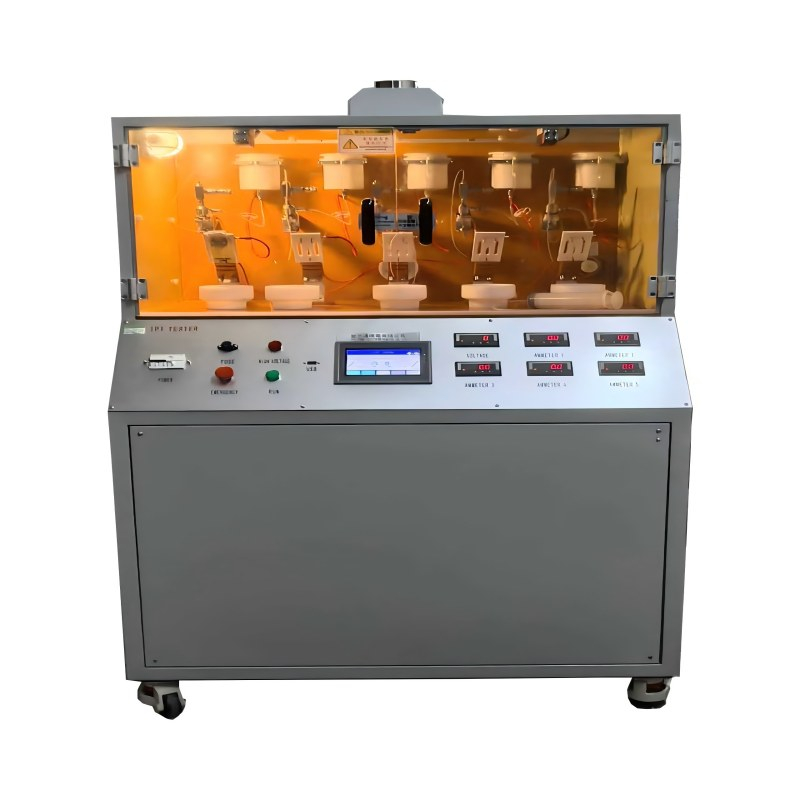
Used to evaluate the tracking resistance of materials:D2132(contaminants:dust and fog) and D3638(contaminant:conductive liquid drops),according to ASTMD 2303 and IEC 60587. It is primarily used to evaluate the tracking resistance and erosion resistance of electrical insulating materials under severe environmental conditions. The test is conducted using a liquid contaminant and an inclined plane specimen at a frequency of 48~62 Hz to assess the material's performance under severe environmental conditions.
Technical Parameters:
l Ambient temperature: +5-+40°C, relative humidity: (20-90)%RH, atmospheric pressure: 80-106kpa, no violent shaking, vibration, electromagnetic interference, dust, explosive or corrosive gas, with good heat dissipation.
l Power supply: AC 220V ± 2%, 50HZ ± 1%, 1 KVA;
l Solution pump drive: Compressed air, pressure > 0.2~0.3 mPa;
l Test voltage: 100~7,500 V adjustable, accuracy ±1%; voltmeter accuracy ±1.5%;
l Electrical circuit: The output voltage stability is within ±1%, adjustable from 1 kV to at least 7.5 kV. The rated current per test station is not less than 0.1 A (i.e., 0.5 A for five stations, with each station equipped with an ammeter).
A 200W resistor (tolerance ±10%) is connected in series with each specimen. The resistance values shall be consistent with the following table:
Rate of Application of 0.1%NH4CI0.02% Wetting Agent,mL/min | Voltage Range, KV | Series Resistor, Ω |
0.075 | 1.0 to 1.75 | 1000 |
0.15 | 2.0 to 2.75 | 10000 |
0.30 | 3.0 to 3.75 | 50000 |
0.60 | 4.0 to 4.75 | 50000 |
0.90 | 5.0 to 6.0 | 50000 |
l Electrodes: Compliant with Figure 2 of ASTMD 2303; installation method as per Figure 3; Upper and lower electrodes are made of 302 stainless steel, 0.5 mm thick;
l Test stations: 5 stations, independently controlled;
l Control method: PLC touchscreen.